
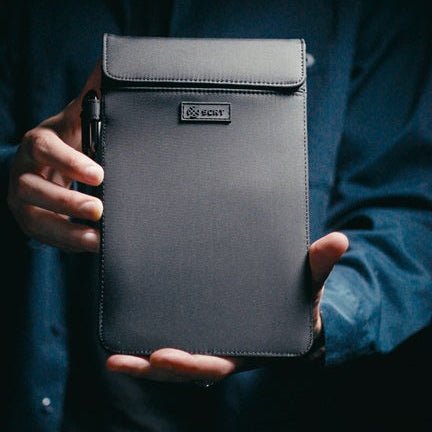
By Blake Marston, founder, SCRT (New Plymouth)
"Which one do I need?" Match the bag to the device, and to how you'll use it. Car keys need a small snap-close pouch, or a box by the door if several people come and go. A phone can go in a magnetic sleeve, a roomier fold-over bag, or a waterproof bag for wet weather.
For tablets and laptops, use the internal measurements and don't force a tight fit, because a stretched opening is how signals leak. I haven't fitted every current phone and laptop in these bags myself. The size notes below are based on official device measurements and our published internal sizes, not a hands-on test. Whatever you pick, close it fully and run the call test or the car-door test in Do Faraday bags really block your phone?.
Prices below were checked on the live product pages on 24 November 2026 and include GST. They can change, so confirm on the product page when you order.
The short version
| Product | Price | Closure | Size / fit | Suited to |
|---|---|---|---|---|
| Key Fob Faraday Bag | $49 | Snap | External 13.7 × 10.5 cm; internal usable 10.5 × 9 cm | Keys when you're out, or a single fob at home |
| Digital Detox Box | $129 | Magnetic lid | 23 × 19.8 × 6.6 cm; up to 6 phones, or a mix of phones, fobs and wallets | Several keys or phones by the door |
| Faraday Phone Sleeve, Large | $135 | Magnetic | Internal usable 20 × 13 cm; external 23.5 × 14.4 cm | The one most people should start with. Fits large phones, and phones in a typical case |
| Faraday Phone Sleeve, Medium | $119 | Magnetic | Internal usable 16 × 9 cm; external 21.5 × 12.3 cm | Smaller phones only, bare or in a slim case |
| Small Faraday Bag for Phones | $79 | Fold-over | Internal closed 21 × 13.5 cm; fits up to 4 phones | Several phones, or a phone plus a passport or fob |
| Waterproof Faraday Phone Bag | $89 | Fold over three times and clip | Internal closed 18 × 9.5 cm; 29 × 12 cm open | One phone in wet weather |
| Medium Faraday Bag for Tablets | $109 | Fold-over | Internal 32 × 24 cm | A 13-inch tablet or small travel laptop, not a 15-inch or 16-inch MacBook |
| Large Faraday Bag for Laptops | $169 | Fold-over, Velcro | Internal 41 × 29 cm; fits a 16-inch laptop | A 16-inch laptop in a fold-over bag |
| Premium Faraday Laptop Sleeve | $199 | Magnetic | Internal 41 × 30 cm; external 43.5 × 32 cm; fits 15/16-inch laptops and smaller | A 16-inch laptop in a slimmer sleeve |
| Faraday Sling Bag | $159 | Magnetic on the Faraday sleeve | Built-in sleeve fits phones up to 19 × 10.5 cm (length × width) | Everyday carry, with a built-in phone sleeve |
| The Commuter Faraday Backpack 18L | $389 | Magnetic on the removable laptop sleeve | Removable sleeve 41.5 × 29 cm (usable 40 × 27 cm), up to 16 inches; built-in Faraday pocket usable 23 × 24 cm | If you already want a backpack, with Faraday pockets inside |
How it works
A Faraday bag is a closed pouch lined with conductive fabric. Radio waves hit that layer and are reflected and absorbed, so almost none get in or out. That only holds while the bag is fully closed. The closure is as important as the fabric, which is why the way each bag shuts is in the table above.
People sometimes call the larger phone bags roll-top. Ours use a fold-over closure: you fold the top over and fasten it. On the waterproof bag, fold the top over three times and clip the buckles. The phone sleeves, the Premium Faraday Laptop Sleeve, and the Commuter's removable laptop sleeve use a magnetic closure. The cheaper Large Faraday Bag for Laptops is fold-over, fastened with Velcro. The key-fob pouch uses a snap.
The device, case included, has to sit fully below that closure. If you have to stretch the opening to get it in, the seal may not hold. Size up.
For car keys
If you drive a keyless car, one that unlocks from the mere presence of the fob, without a button press, a working pouch stops the radio signal a relay attack needs. It is one useful layer, not a complete defence. There's more on how those attacks work in New Zealand in Keyless car theft in NZ: how relay attacks work, and the 30-second fix.
- When you're out, or for a single fob at home: the Key Fob Faraday Bag ($49), snap closure, with a removable carabiner.
- For several fobs, or a drop-in by the door: the Digital Detox Box ($129). The lid uses eight magnets. Place the phone or fob inside, close the lid, wait two minutes for the signal to drop fully, then test.
Test either one at your own car: put the fob in, close it fully (and wait those two minutes if you're using the box), stand next to the car and try the handle. If it unlocks, it isn't working. The method is in the Wellington lab post.
For phones
- A slim magnetic sleeve for one phone: start with the Faraday Phone Sleeve, Large. That is the right pick for most people, including Plus, Pro Max, Ultra and Pro XL models, and phones in a typical case. Choose Medium only for a smaller phone, bare or in a slim case. The front pocket isn't shielded.
- A roomier fold-over bag for more than one device: the Small Faraday Bag for Phones. The product page says it fits up to four phones, plus things like a passport or a fob.
- A waterproof bag for wet weather: the Waterproof Faraday Phone Bag. Fold the top over three times and clip the buckles. On measurements, the 18 × 9.5 cm internal size should take the large phones below, including a typical case.
There's a wider range in the For Phones collection.


Will my phone fit? A measurement guide
This is not a hands-on fit list. Start with the Large sleeve unless you have a smaller phone, bare or in a slim case. I compared official manufacturer sizes with our published internal measurements, then added a typical case of about 2 to 4 mm on each side, which adds 4 to 8 mm to the height and to the width. The table uses the more cautious end of that range, +4 mm each side. A slim case sits at the lower end. A bulky or wallet case can be larger still, so measure yours if you're unsure. The phone, case on, has to sit fully below the magnetic flap or the fold-over seal.
| Phone | Large sleeve (20 × 13 cm) | Medium sleeve (16 × 9 cm) | Waterproof bag (18 × 9.5 cm) |
|---|---|---|---|
| iPhone 16 | Should fit, including a typical case | Should fit bare or a slim case; snug with a typical case | Should fit, including a typical case |
| iPhone 16 Plus | Should fit, including a typical case | Too big, even bare (160.9 mm long, against 160 mm internal) | Should fit, including a typical case |
| iPhone 16 Pro or iPhone 17 | Should fit, including a typical case | Should fit bare or a slim case; snug with a typical case | Should fit, including a typical case |
| iPhone 16 Pro Max or iPhone 17 Pro Max | Should fit, including a typical case | Too big, even bare | Should fit, including a typical case; tighter than the Large sleeve |
| iPhone 17 Pro | Should fit, including a typical case | Should fit bare or a slim case; snug with a typical case | Should fit, including a typical case |
| iPhone Air | Should fit, including a typical case | Bare is already snug; a typical case is likely too big | Should fit, including a typical case |
| Galaxy S25 | Should fit, including a typical case | Should fit, including a typical case | Should fit, including a typical case |
| Galaxy S25+ | Should fit, including a typical case | Bare is already snug; a typical case is likely too big | Should fit, including a typical case |
| Galaxy S25 Ultra | Should fit, including a typical case | Too big, even bare | Should fit, including a typical case |
| Pixel 9, 9 Pro, 10 or 10 Pro | Should fit, including a typical case | Should fit bare or a slim case; a typical case is likely too tight | Should fit, including a typical case |
| Pixel 9 Pro XL or Pixel 10 Pro XL | Should fit, including a typical case | Too big, even bare | Should fit, including a typical case |
The Small Faraday Bag for Phones (21 × 13.5 cm internal closed) and the built-in sleeve on the Faraday Sling Bag (up to 19 cm long and 10.5 cm wide) should fit every phone in that table, including a typical case, on these measurements. Only the sling's Faraday sleeve is shielded, not the whole bag, and not the front slip-in pocket on the phone sleeve.
Cheryl, who bought a Faraday Phone Sleeve, wrote that she has "a large phone and it fits inside this faraday pouch perfectly." She didn't name the model or say whether a case was on, so I haven't treated that as a Pro Max proof point. If it's close, choose Large.
For tablets and laptops
The same case assumption applies: about 2 to 4 mm each side for a typical slim sleeve. That does not include a keyboard cover. If you use a Magic Keyboard or a thick sleeve, measure it, or use the large bag.
| Device (official footprint) | Medium tablet bag (32 × 24 cm) | Large laptop bag (41 × 29 cm) or Premium sleeve (41 × 30 cm) |
|---|---|---|
| iPad Air 11 (24.76 × 17.85 cm) or iPad Pro 11 (24.97 × 17.75 cm) | Should fit, including a typical slim case | Should fit |
| iPad Air 13 (28.06 × 21.49 cm) or iPad Pro 13 (28.16 × 21.55 cm) | Should fit, including a typical slim case | Should fit |
| MacBook Air 13 (30.41 × 21.50 cm) | Should fit; snug on the long edge (about 1.6 cm of spare length bare) | Should fit |
| MacBook Pro 14 (31.26 × 22.12 cm) | Snug bare (about 7 mm of spare length). A typical slim sleeve is likely too tight. Use the large bag. | Should fit |
| MacBook Air 15 (34.04 × 23.76 cm) or MacBook Pro 16 (35.57 × 24.81 cm) | Too big | Should fit |
That lines up with the list already on the medium bag product page: MacBook Air 13" (M3) a snug yes, iPad Pro 13" (M4) a yes, and MacBook Pro 14" risky (very tight). The same page also lists a Dell XPS 13 as a comfortable yes, an Asus Zenbook S 13 OLED as a yes, and a Surface Pro 11 with keyboard as a yes. Those Windows models are the product page's claims, not a new measurement here.
The Large Faraday Bag for Laptops ($169) is fold-over, fastened with Velcro. The Premium Faraday Laptop Sleeve ($199) has a magnetic closure. Both are the 16-inch options. Logan D, a verified buyer, wrote that the Premium sleeve "fits 16" macbook pro m5 with lots of room" and that "the top seal is great with the magnets." More sizes are in the For Laptops collection.

Backpacks, larger bags and wallets
A backpack is for people who already want a bag, with Faraday pockets inside. Those closures still have to be used. An open pocket is just a pocket.
The Commuter Faraday Backpack 18L ($389) has a removable laptop sleeve (usable 40 × 27 cm, up to 16 inches) that closes with magnets, and a built-in Faraday pocket (usable 23 × 24 cm). Close that built-in pocket fully as well. The bag also has a hidden non-Faraday pocket, so not every compartment is shielded. Cheryl, who uses the Commuter every day, has tested both Faraday parts and wrote that her phone "never rings."
The Freedom Faraday Backpack 30L ($399) is a larger pack. The product page describes it as fully lined. Close it by folding the top down and fastening the buckles. It only works while that closure is sealed.
If you need more capacity, there's the Sovereignty Faraday Dry Bag 20L ($219), which the product page says will take a 16-inch laptop, and a larger Guardian Faraday Duffle Bag for several devices at once. On the duffel, fold the top over three times and buckle it. I haven't published internal measurements for the duffel, so measure your gear if you're unsure. On the dry bag, the zippered outer pocket is unshielded. Kieran fitted a 13-inch MacBook Pro in the dry bag "plus a few other bits of gear."
For cards and a passport, use an RFID wallet, not a phone bag. A Faraday bag also blocks RFID; a wallet does not block a phone or a car key. See the Anti-Theft RFID Wallets collection.
What we measured
In September 2025, RF Test Solutions in Wellington, an IANZ-accredited lab, tested a single layer of our EliteBlock fabric using the IEEE 299 method. It measured 75.1/77.9 dB at 1 GHz, 64.1/69.3 dB at 2.45 GHz, 41.9/48.1 dB at 5 GHz and 55.8 dB at 10 GHz (horizontal/vertical). A separate test of the three-layer construction by the Beijing Institute of Radio Metrology and Measurement measured 50.7 dB to 84.1 dB from 1 to 40 GHz, using a different method, so I keep the two sets of numbers apart.
The bags and sleeves in this guide are lined with three layers of EliteBlock. A properly closed bag also blocks cellular, NFC and key fob signals, which you can check with the tests below. The full report is free to download, and I explain the numbers in Do Faraday bags really block your phone?.
Try it yourself
- For a phone: put it in with mobile data and Wi-Fi on, close the bag fully, wait about ten seconds and ring it. Voicemail is a pass. If it rings, something is leaking. On the Digital Detox Box, wait two minutes after you close the lid before you test, so the signal has time to drop fully.
- For a key fob: put it in, close the pouch or box, stand next to the car and try the door. If it unlocks, it isn't working. Take the fob out and try again to confirm the car normally responds.
On a fold-over bag, fold the top right over and fasten it. On a magnetic sleeve, check it has snapped shut along its full length. On the waterproof bag, fold it over three times and clip the buckles. The method is in the Wellington lab post.
What it doesn't do
- It only works while it's closed. An open bag is just a bag.
- It doesn't turn the device off. The microphone, camera and apps can still run inside, and anything stored can sync once it's out. I cover that more fully in EMF protection in NZ: what shielding actually does, and what it doesn't.
- A tight fit can leak. If you have to stretch the opening, the closure may not seal. Go up a size.
- It isn't a health product, and I don't make health claims about it.
How to choose in one minute
- A keyless car: start with the Key Fob Faraday Bag, and add the Digital Detox Box if several people come and go. Test it at the car.
- A phone: start with the Faraday Phone Sleeve, Large for one phone. That is the one most people should buy, including Plus, Pro Max, Ultra and Pro XL models, and phones in a typical case. Choose Medium only for a smaller phone, bare or in a slim case. Use the Small Faraday Bag for Phones for more than one, and the waterproof bag if it will get wet.
- A laptop: the Large Faraday Bag or the Premium Faraday Laptop Sleeve for 16-inch machines. Use the medium bag for a 13-inch tablet or a small travel laptop, not for a tight 14-inch MacBook Pro, and not for a 15-inch or 16-inch MacBook.
- A backpack: the Commuter has Faraday pockets inside. You still have to close them.
FAQ
Which Faraday bag do I need for my phone? Start with the Large Faraday Phone Sleeve (20 × 13 cm internal) for most people, including Plus, Pro Max, Ultra and Pro XL models, and phones in a typical case. Choose Medium (16 × 9 cm internal) only for a smaller phone, bare or in a slim case, such as an iPhone 16, iPhone 17, iPhone 17 Pro or Galaxy S25. The Small Faraday Bag if you want more than one device in it. The waterproof bag if it needs to cope with weather. These notes are based on official device sizes and our internal measurements, not a hands-on test of each model.
Will my phone fit with a case? Use the published internal usable size, not the external one. The device, case included, must sit fully below the magnetic flap or fold-over seal. I've assumed a typical case adds about 2 to 4 mm on each side. If it's close, go up a size. A stretched opening can leak.
What's the difference between a sleeve, a fold-over bag and a waterproof bag? The sleeve is slim, magnetic, and made for one phone. The Small Faraday Bag is roomier, with a fold-over closure, and the product page says it fits up to four phones. The waterproof bag is sized for one phone; you fold the top over three times and clip it. Same shielding idea, different carrying and weather.
Key-fob pouch or Digital Detox Box, which one? The pouch for a single fob, and for when you're out. The box at home if several people come and go, or you want a drop-in by the door. You can use both. With the box, place the device inside, close the lid, wait two minutes, then test.
Will my 16-inch laptop fit? The Large Faraday Bag (internal 41 × 29 cm, fold-over with Velcro) and the Premium Faraday Laptop Sleeve (internal 41 × 30 cm, magnetic) are the 16-inch options. A verified customer has fitted a 16-inch MacBook Pro M5 in the Premium sleeve with room to spare. The medium bag is for tablets and smaller travel laptops. A MacBook Pro 14-inch is snug in that bag and likely too tight with a typical sleeve. A 15-inch or 16-inch MacBook is too big for the medium bag.
How do I know the bag I picked actually works? Close it fully and run the call test or the car-door test. On the Digital Detox Box, wait two minutes after you close the lid before you test. The method is in our Wellington lab post.
Everything we make is designed and made in New Zealand and ships from New Plymouth, with a 2-year warranty. See our EMF protection products and our FAQ page.
Sources
- SCRT product pages, prices and dimensions checked 24 November 2026, NZDT (Pacific/Auckland): Key Fob Faraday Bag, Digital Detox Box, Faraday Phone Sleeve, Small Faraday Bag for Phones, Waterproof Faraday Phone Bag, Medium Faraday Bag for Tablets, Large Faraday Bag for Laptops, Premium Faraday Laptop Sleeve, Faraday Sling Bag, The Commuter Faraday Backpack 18L, Freedom Faraday Backpack 30L, Sovereignty Faraday Dry Bag 20L, Guardian Faraday Duffle Bag
- Official device sizes, checked 24 November 2026: iPhone 16, iPhone 16 Pro, iPhone 16 Pro Max, iPhone 17, iPhone Air, iPhone 17 Pro, iPhone 17 Pro Max, Galaxy S25 and S25+, Galaxy S25 Ultra, Pixel 9, Pixel 9 Pro and Pro XL, Pixel 10, Pixel 10 Pro and Pro XL, MacBook Air, MacBook Pro, iPad Pro, iPad Air
- RF Test Solutions Ltd, SCRT EliteBlock Faraday Shielding Test Report, September 2025
Blake Marston is the founder of SCRT, based in New Plymouth. Before SCRT he spent about 18 years as a firefighter. Got a question about this post? Drop us a line at hello@scrt.nz.